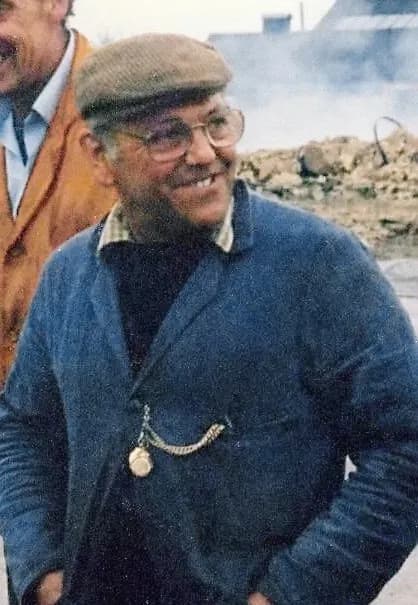
The son of a bleach works labourer and a charwoman turned Bolton's industrial heritage into a television career that captivated millions.
Fred Dibnah, born on 28 April 1938 in Bolton, spent his life climbing the chimneys that defined his town's skyline and mourning the industrial craftsmanship they represented. His journey from local joiner to BAFTA-winning television personality mapped the decline of British industry and the rediscovery of its working-class heroes.
Early Life in Bolton's Industrial Heyday
Dibnah grew up in a town powered by steam. The textile mills that dominated Bolton's landscape fascinated him from childhood, particularly the engines that drove them and the towering chimneys that vented their smoke. His commute to school took him past the steeplejacks who maintained these structures, and he developed an early fascination with their craft.
Academic struggle marked his school years. Placed in art classes due to poor literacy, Dibnah spent three years at art college focusing on industrial subjects: machinery, pithead gear, and spinning mills. After a brief and unhappy stint at a funeral parlour, he began working at a local joinery workshop at age sixteen, where he first learned to scale ladders and work at height.
The Career That Began With a Bet
Dibnah's entry into steeplejacking came through audacity rather than formal apprenticeship. Aged seventeen or eighteen, he climbed a 262-foot chimney at Barrow Bridge for a ten shilling wager, securing two Union Flags to the lightning conductors near the summit. The feat was witnessed from his father's allotment near Raikes Park greyhound track, where Dibnah had watched his first chimney demolition years earlier.
After completing National Service in the Army Catering Corps between 1960 and 1962, he returned to Bolton and established himself as a steeplejack. His breakthrough came in the 1970s when he repaired the weathervanes at Bolton Parish Church and gilded them. The publicity from this job, which required climbing the 180-foot tower, provided the foundation for his future business.
Repairing Bolton's Landmarks
Dibnah's restoration work shaped the skyline his fellow townspeople see today. In 1978, he undertook a major project at Bolton Town Hall, repairing the clock tower and sixteen stone pillars at the summit. He sourced new stone, built a lathe in his workshop, and crafted replacement pillars by hand. The work also included gilding the golden sphere that crowns the building.
His connection to Barrow Bridge remained strong throughout his life. Decades after his youthful wager, he returned in 1996 to repair the same 262-foot chimney he had climbed as a teenager. During this project, he installed a peregrine falcon nest at the summit and successfully campaigned to have the structure listed for preservation. He also undertook work for local breweries, which eventually led to his connection with the vicar of Bolton.
Shot to Fame
A BBC film crew visited Bolton in 1978 to document the Town Hall restoration. Producer Alistair MacDonald interviewed Dibnah from the top of the building, capturing his broad Lancashire accent, self-taught philosophical observations, and enthusiastic manner. The resulting documentary, Fred Dibnah, Steeplejack, broadcast in 1979, won a BAFTA award for best documentary and transformed a local tradesman into a national figure.
The programme's success launched a television career spanning two decades. Dibnah admitted he found speaking to camera more nerve-racking than climbing chimneys, but his authenticity proved irresistible to viewers. His boyish exclamation "Did you like that?" after felling a chimney in Rochdale became his unofficial catchphrase.
Industrial Evangelist
The documentaries gave way to a series of programmes that cemented Dibnah's role as an unlikely historian and preservationist. Fred Dibnah's Industrial Age aired in 1998 to high viewing figures, becoming the second most-visited page on the BBC website at the time. This was followed by Fred Dibnah's Victorian Heroes in 2001, marking the centenary of Queen Victoria's death, and Fred Dibnah's Age of Steam in 2003.
Throughout these programmes, Dibnah mourned the loss of Britain's industrial base and the traditional craftsmen who built it. He spoke of the stonemasons who created chimneys with "great big stones perched two hundred feet up in the sky, covered in incredible carvings and all fitting perfectly, in an attempt to keep them up for ever." This reverence made him reluctant to demolish structures he understood as monuments to working-class skill.
Life on Radcliffe Road
Dibnah made his home at 121 Radcliffe Road, a Victorian gatehouse on the Earl of Bradford's estate. He spent years restoring the property, building extensions using old gravestones as lintels and mullions. The garden became a showcase for his other passion: steam engines.
He acquired a 1910 Aveling and Porter steamroller, which he named Alison after his first wife, and a 1912 Aveling and Porter traction engine. The latter sold at auction in 2010 for £240,000. In his garden workshop, he built steam-driven machinery and demonstrated Victorian engineering techniques to visitors. The property later became the Fred Dibnah Heritage Centre, though it has since closed to the public.
The Chimney His Mother Could Not Escape
One of Dibnah's earliest projects had unexpected consequences for his family. At sixteen, he constructed a replacement chimney at his mother's house on Alfred Street in Bolton. The Bolton council later placed a preservation order on the structure, meaning it could not be demolished. His mother, Betsy Dibnah, reportedly complained about living with the chimney for decades: "He clapped that chimney on the roof when he was sixteen, I've had to live with it ever since. It's awful."
The chimney remained standing as of 2007, a physical reminder of how Dibnah's work became embedded in the fabric of Bolton itself.
A Master of His Craft
Dibnah's chimney-felling technique was as dangerous as it was precise. He cut an ingress at the base of the structure, supported it with wooden props, and burned the props to collapse the chimney in the intended direction. Over his career, he felled ninety chimneys, the last in Royton, Manchester, in May 2004.
A near-death experience in 1997 at Canvey Island illustrated the risks. A concrete chimney began collapsing prematurely, sending 2,500 tonnes of concrete leaning toward him. The structure ultimately fell in the opposite direction, but the incident demonstrated the peril inherent in his chosen profession.
Final Years and Legacy
Dibnah was diagnosed with bladder cancer in 2001, with a tumour first detected on his kidney. He underwent chemotherapy at Christie Hospital in Manchester but died in Bolton on 6 November 2004, aged sixty-six. He was appointed Member of the Order of the British Empire before his death.
He is buried at Tonge Cemetery, Bolton. His grave, like the chimneys he climbed and the steam engines he restored, has become a site of pilgrimage for those who admired his commitment to Britain's industrial heritage.
What Remains in Bolton
Fred Dibnah's legacy in Bolton extends beyond his television programmes. The Town Hall he restored, the Barrow Bridge chimney he preserved, and even his mother's chimney on Alfred Street stand as monuments to tradesmanship that television made famous but Bolton knew first. The skills he practised, documented, and celebrated are increasingly scarce, but the structures he maintained remain part of the town's daily landscape.
His life traced the arc of Bolton's transformation from industrial powerhouse to post-industrial town, and his work keeping the town's landmarks intact ensured that the craftsmanship of the past would continue to be visible in the present.