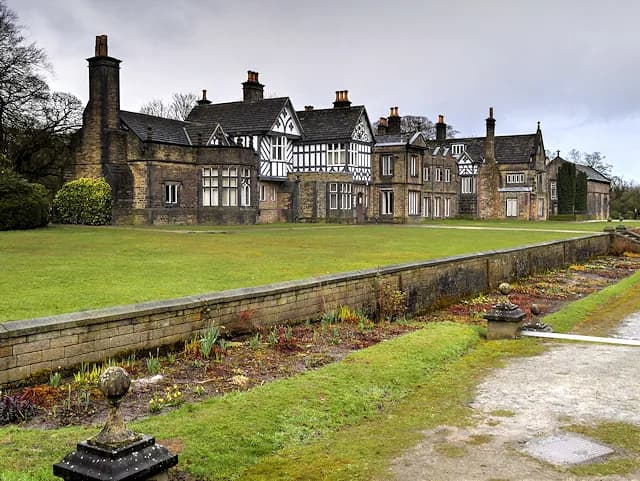
Smithills Hall stands on the slopes of the West Pennine Moors as one of the best-preserved medieval manor houses in North West England, its timber-framed wings and stone mullions bearing witness to more than six centuries of Lancashire history.
From Medieval Farmstead to County Stronghold
The manor takes its name from the Old English smeþe (smooth) and hyll (hill), recorded as "Smythell" in 1322. William de Radcliffe acquired the estate in 1335 and built the original timber-framed hall, including what is now the Great Hall, in the early 14th century. The location at 500 feet above sea level, three miles north-west of Bolton town centre, placed the house strategically between agricultural land and the wild moorland above.
The Great Hall remains the heart of the building. It was constructed as an open hall where the family and their servants ate, worked, and slept in a single space, warmed by a central hearth. Much of the original medieval structure survives, including the roof timbers and the basic plan of the room.
The Radcliffe male line failed in 1485, and the estate passed through marriage to the Barton family. Andrew Barton, who inherited around this time, added the Withdrawing Room with its intricately carved Flemish linen-fold panelling. The panelling includes carved portraits of Barton family members and a rebus; a picture puzzle showing a bar across a tun (barrel), spelling out the family name.
The Green Room and the Martyr's Footprint
The hall's best-known story concerns George Marsh, a Protestant preacher from Deane, who was brought to Smithills Hall in 1554. Robert Barton, son of Andrew, served as Justice of the Peace and interrogated Marsh during the Marian persecutions under Queen Mary I. The examination took place in what is now called the Green Room.
Marsh refused to renounce his Protestant faith. According to local legend, as he was led away, he stamped his foot so firmly on the stone floor to affirm his belief that it left a permanent impression. Visitors to the hall can lift a wooden shutter at the entrance to the Withdrawing Room to see this "Footprint of Faith" for themselves. A sign nearby identifies it as the footprint of "the reverend George Marsh of Deane, Martyr who was examined at Smithills and burnt at Chester in the reign of Queen Mary."
Marsh was sent to Chester for trial, found guilty of heresy, and executed at Boughton on 24 April 1555. Folklore holds that the footprint "bleeds" each year on the anniversary of his death. The first written record of this story dates to 1787, more than 200 years after the events it describes.
The Winter Hill Trespass and Public Access
Smithills Hall played a role in another chapter of local history in 1896. Colonel Henry Ainsworth, who had acquired the estate in 1801, closed Coalpit Road to prevent public access to Winter Hill moorland, which he wished to reserve for grouse shooting. On 6 September 1896, approximately 10,000 protesters marched from Bolton and broke down the gate. A second march on 13 September drew 12,000 participants.
The case eventually reached the Manchester Chancery Court in March 1897, where Vice Chancellor Hall ruled in favour of Ainsworth. Ten defendants had costs awarded against them. The campaign continued for two decades, and one of the defendants, Solomon Partington, was elected as a councillor in 1904. By 1996, Coalpit Road was declared a public right of way. A commemorative stone on the road marks the trespass, which is recognised as a forerunner to the Kinder Scout mass trespass of 1932 and the wider "right to roam" movement.
Victorian Grandeur and Public Ownership
The Ainsworth family, who had made their fortune in the bleachworks at Barrow Bridge, employed architect George Devey in 1875 to extend and modernise the hall. Devey added the west wing, which includes a dining room, library, and guest bedrooms decorated in William Morris and Arts and Crafts styles. The Devey Room was fully refurbished in 2018.
The estate passed through various hands during the early 20th century. In 1938, the Ainsworth family sold Smithills Hall to Bolton Corporation, and it has remained in public ownership ever since. The oldest parts opened as a museum in 1963, and the museum was extended into the Victorian wings during the 1990s. The west wing was restored by the council in 1999.
Visiting Smithills Hall Today
Smithills Hall is a Grade I listed building and scheduled monument. It is owned by Bolton Council and managed by Bolton Library and Museum Service in partnership with the Friends of Smithills Hall, a registered charity.
The hall is open to visitors free of charge on Wednesdays, Thursdays, Fridays, and Sundays from 10am to 4pm (noon to 4pm on Sundays). Guided tours are available on request. The Bake and Roast tea room, an artisan food producer, operates on the ground floor serving homemade and locally sourced produce from Wednesday to Sunday.
The estate encompasses 48 hectares of gardens and pleasure grounds, including a parterre garden, steep wooded valley, and lake. Smithills Country Park extends to over 1,000 acres, with the Woodland Trust now owning much of the former estate land.
The hall has attracted attention beyond Bolton, appearing on the television programmes Most Haunted in 2005 and Great British Ghosts in 2012. It has also served as a filming location for various productions.
For further information, contact Smithills Hall on 01204 332812 or email historichalls@bolton.gov.uk.